

A first Japanese One Piece TCG wholesale order is easier to manage when the quote answers five questions: which set you are buying, what each unit contains, how much the shipment costs, when it can leave Japan, and what happens if the delivery arrives damaged.
A low box price alone does not answer those questions. This guide gives retailers a practical checklist for comparing quotes and placing an opening order that fits their shop.
Start with the exact set code and language
Write the set code alongside the product name. Codes such as OP-16 and OP-17 help distinguish products when titles are translated or shortened. Also state that you want the Japanese edition. Artwork and set names can look similar across regional listings.
For example, browse One Piece OP-17: The World’s Strongest Warriors and One Piece OP-16: Moment of the Decisive Battle as separate items in your enquiry. Ask the supplier to confirm the precise edition, packaging and current availability for each.
Before paying, compare the product description with the official Japanese One Piece Card Game product listings. If your customers buy cards for organised play, check the language rules of their tournament region separately; a Japanese retail listing does not establish local tournament eligibility.
Confirm what “box” and “case” mean on the quote
A booster box is a retail display containing packs. A case is an outer carton containing multiple boxes. A shipment of loose boxes is not necessarily an unopened manufacturer case, even when the number of boxes is the same.
Ask for the following details in writing:
- Set code, edition and product format.
- Packs per box and boxes per case for that specific item.
- Whether the outer carton is unopened or the order will contain loose boxes.
- Any cosmetic damage, opened outer packaging or other condition notes.
- Whether the price is per pack, per box or per case.
Do not apply one case quantity to every One Piece product. Booster releases, special collections and other formats need their own confirmation. Our One Piece box-versus-case guide explains the buying decision in more detail.
Build an opening order around your customers
Start with products your shop can explain and sell. A retailer with regular One Piece buyers may have a different opening order from a Pokémon-focused store adding its first One Piece shelf.
Look at your own customer requests, recent sales and available cash. Decide how much you can leave tied up in inventory while waiting for delivery and sell-through. Treat expected demand as a planning assumption, not a guaranteed outcome.
One set or a mixed order?
A single-set order is simpler to price, count and reorder. A mixed order can help you learn which releases your customers prefer. Ask whether different sets can be combined to meet the supplier’s minimum order quantity, and whether some items have their own minimums.
Keep a record for each line: set code, number of boxes, quoted price and planned retail price. Do not assume a product page means stock has been reserved for you. Confirm availability and quote validity before payment.
Compare landed cost, not just the Japanese box price
Landed cost is what it takes to get the stock ready for sale at your business. Include the goods, freight, payment or currency-conversion fees, and applicable import or clearance costs. Ask which charges the quote includes and which remain payable by the buyer.
For a shipment of identical boxes, a simple planning calculation is:
Estimated cost per box = total goods and delivery-related costs ÷ number of saleable boxes.
A worked example with fictional numbers
Suppose 12 boxes cost ¥180,000, shipping costs ¥12,000, payment fees are ¥3,000 and your estimated import or clearance costs are ¥15,000. The total is ¥210,000, or ¥17,500 per box.
These figures are an illustration, not a Nippon TCG offer, a current market price or a tax calculation. For a mixed shipment, allocate freight and other costs consistently rather than assuming every item costs the same to transport.
When checking potential margin, also allow for your sales platform fees, domestic delivery, packaging, returns and any applicable tax treatment. Use a conservative selling price. A popular release can still be a poor purchase if your total costs are too high.
Check sealing, condition and order documentation
Request clear photos of the actual stock when available, especially when outer-carton condition matters to your customers. Ask what photos can be supplied before dispatch and how the boxes will be protected inside the shipping carton.
Seals and photographs are useful checks, but they are not a standalone guarantee of authenticity. Review the seller’s business details, invoice, product description, payment recipient and written terms together. Ask about sourcing rather than assuming every wholesaler is an authorised distributor.
Keep your final quote, invoice, payment receipt and correspondence in one place. The set codes and quantities should agree across the documents. For a broader checklist, read our guide to checking authentic Japanese sealed TCG products.
Separate dispatch time from delivery time
A carrier’s transit estimate begins after the parcel is handed over. It does not include time needed to confirm payment, prepare the order or wait for an allocated product.
Ask the supplier for an expected dispatch window, the carrier, tracking arrangements and the process for delays. If an item is a preorder, confirm the release timing, allocation conditions and cancellation terms. Avoid advertising a firm arrival date to your customers before those details are clear.
Give your complete business delivery address and destination postal code with the quote request. Confirm any insurance, customs responsibilities and claim deadlines in the written shipping terms. See our Japanese TCG shipping guide for the questions to ask before dispatch.
Use this first-order quote checklist
Copy this template into your enquiry:
- Business: shop name and contact person.
- Product: Japanese One Piece TCG set name and code.
- Quantity: number of boxes or unopened cases; ask for confirmed units per case.
- Condition: required sealing and acceptable packaging condition.
- Destination: country, city and postal code.
- Pricing: item prices in JPY, shipping, fees and quote expiry.
- Timing: stock availability and expected dispatch window.
- Payment: available method, recipient details and confirmation process.
- After delivery: inspection, damage-reporting deadline and claim procedure.
A complete enquiry reduces the need for several rounds of clarification. It also gives you a written basis for comparing suppliers fairly.
One Piece products to include in your enquiry
Use the current product pages to identify what you want, then ask for an up-to-date quote:
- OP-17: The World’s Strongest Warriors — specify the Japanese edition and required box or case quantity.
- OP-16: Moment of the Decisive Battle — compare its quoted cost with the products your customers request.
- Browse the full Nippon TCG catalogue — check other formats and ask whether a mixed order is possible.
Product availability, minimum quantities and pricing can change. Confirm the details of the exact item before committing to an order.
Frequently asked questions
Can I buy a single box before placing a wholesale order?
Ask before submitting payment. Sample orders and minimum quantities depend on the supplier and item. If a single box is not available, discuss the smallest eligible order and whether different products can be combined.
Is a sealed case always cheaper per box?
No. Compare the quoted unit price and delivery costs. An unopened case may have a different price from loose boxes because packaging condition and supply differ. Work from the quote rather than assuming a fixed case discount.
Does a case guarantee particular rare cards?
Do not build a resale calculation around unverified pull-rate claims. Confirm any official product information for the exact release, and avoid presenting community observations as a manufacturer guarantee.
Does submitting a quote request confirm my order?
On Nippon TCG, a quote request begins the pricing discussion. Review the quote in your account and follow the payment instructions. A payment-proof submission creates an order for verification. Keep the quote and order references for later messages.
What should I do when the parcel arrives?
Inspect the shipping carton and record visible damage before unpacking. Count the products against the invoice, retain the packaging and contact the supplier promptly if there is a discrepancy. Follow the agreed evidence requirements and claim deadlines.
Ready to request your first order?
Send the set codes, quantities and delivery destination through Nippon TCG’s wholesale quote request. Ask for the confirmed product format, final costs and dispatch terms. A clear first quote is the foundation for an order you can plan, track and check when it arrives.
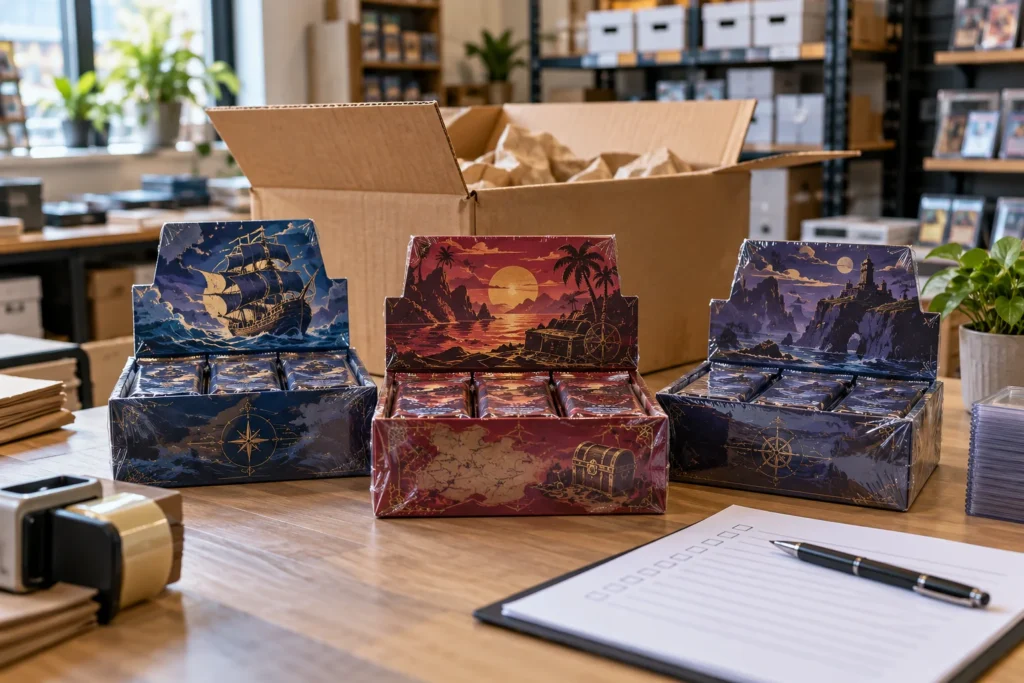
Editorial note: the featured image is an AI-generated illustration of a trading-card stock receiving scene, not a photograph of Nippon TCG inventory. The cost example uses fictional figures. Product details and availability should be confirmed on the relevant listing and written quote.