

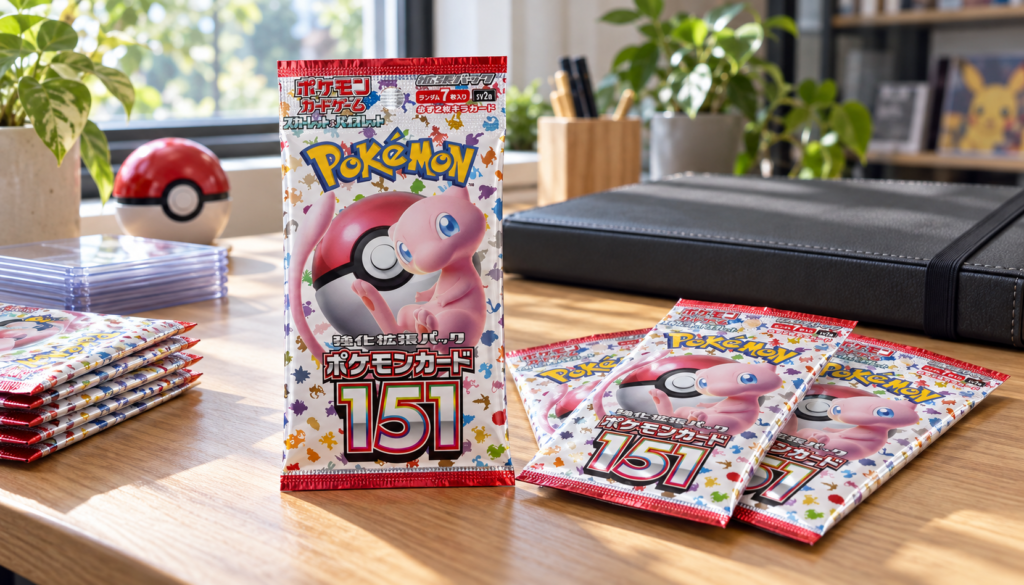
A Japanese Pokémon 151 booster box is a sensible choice when you want the Japanese SV2a set focused on the original 151 Pokémon. Before buying, confirm the edition, the 20-pack box format and its condition. A sealed box offers a pack-opening experience; it does not guarantee the individual cards you want or a complete collection.
Understand the collection: Pokémon, card types and variants
The number 151 describes the original Pokémon lineup, not a promise that a box completes your collection. Think of the set in layers. First, there are the Pokémon you want to represent in a binder. Next, there are different card designs and treatments. Finally, there are the particular versions you choose to collect. Those layers can make two collectors’ “complete 151 collections” look quite different.
For example, a returning collector might want one card for each favourite Kanto Pokémon. Another might want selected illustrations featuring Bulbasaur, Charmander and Squirtle and their evolutions. A retailer should ask which goal the customer means before recommending a sealed box or a checklist. Familiar characters make the set approachable, but they do not remove the randomness of packs.
Card labels are also useful. Pokémon ex identifies a card type; it is not the same thing as an illustration rarity. AR means Art Rare and SAR means Special Art Rare in Japanese set terminology. A card can feature a familiar Pokémon and still have several versions that need separate identification. When buying singles later, compare the printed card number, language and finish, rather than just the character name.
A practical binder plan for Japanese 151
- Choose a scope. Decide whether you want favourite characters, one example of each Pokémon or a more detailed variant collection.
- Record what you own. Use card numbers and leave notes for different finishes. Photographing a binder page can help, but it is not a substitute for an accurate checklist.
- Separate opening money from completion money. Keep some of the budget for missing singles rather than spending everything on random packs.
- Protect cards as you sort. Use sleeves and suitable storage, with clean hands and a clear working surface.
- Review the gaps. Once duplicates build up, compare singles prices and condition before deciding whether another box still suits your goal.
This approach also works for a shop running a collecting club. It gives customers a purpose beyond chasing an expensive card, and it helps staff explain the difference between collecting a theme and completing every variant. Do not advertise a “master set” without defining precisely what your list includes.
Box, packs or case: make the purchasing unit explicit
A display box is convenient when you want a clearly described quantity of packs. Individual packs can fit a smaller budget, but the seller should explain their source and condition. A larger order may be supplied as boxes or as an unopened case. The physical carton matters if your customers specifically want an untouched case, so ask whether that is what the quote actually offers.
The Pokémon case-versus-box guide provides broader retailer context. For Japanese 151, obtain the case quantity from the exact offered listing and quotation. Do not use a case count from Korean 151 or a different Japanese release simply because both products carry the Pokémon name.
What is Japanese Pokémon 151?
Pokémon Card 151 belongs to the Japanese Pokémon Card Game Scarlet & Violet series. The official product page describes a lineup running from Bulbasaur to Mew in Pokédex order, with Pokémon ex and illustrated cards among the set’s features. Japanese packs contain seven randomly inserted cards and were released on 16 June 2023. Source: official Pokémon Card 151 product information.
The SV2a code helps identify the release, but a set name alone is not enough to describe an order. Include “Japanese” and “booster box” when asking a supplier for stock. The Japanese display box listed by Nippon TCG contains 20 packs. That means 140 cards in total, not 140 different cards; duplicates are possible.
Choose a box for the experience, singles for a specific card
If your goal is to enjoy opening packs with friends or introduce customers to the set, a box provides a clear purchasing unit. If your goal is one particular illustration or to fill the final gaps in a binder, compare the cost of buying those cards individually. Repeatedly opening boxes is not a reliable way to obtain a named card within a fixed budget.
For a shop, separate these two customer needs. A sealed-product listing should explain the pack format and random contents. A singles listing should show the exact card number and condition. Neither should imply that the packaging artwork promises a particular pull.
Five checks before you approve a quote
- Edition: the quote should say Japanese Pokémon Card 151, SV2a.
- Unit: confirm 20 packs per box and the number of boxes supplied. If buying a case, obtain its box count in writing.
- Condition: ask whether the box has its original wrap and whether there is any crushing, tearing or other damage.
- Actual stock: distinguish a catalogue image from photographs of the items being offered.
- Total cost: confirm product cost, freight and any charges excluded from the quote before comparing suppliers.
Wrap is a condition detail, not conclusive proof of authenticity. Consider the written product description, seller identity, payment documentation and clear photographs together. If the description and images disagree, resolve that discrepancy before paying.
Plan stock around customers who actually want Japanese cards
Ask existing customers whether they want sealed Japanese boxes, singles or English-language products. Interest in the Pokémon characters does not automatically mean interest in every language edition. Start with a quantity you can explain and sell, then use recorded enquiries and actual sales to guide a reorder.
Compare delivered cost per box using the same condition and quantity. A hypothetical order of four boxes with a total delivered cost of 400 currency units has a delivered cost of 100 per box. That is a calculation example, not a Nippon TCG price. Your selling price must also allow for the costs of running your sales channel.
Frequently asked questions about Japanese Pokémon 151
How many packs are in a Japanese Pokémon 151 booster box?
The Japanese SV2a box listed by Nippon TCG contains 20 packs, with seven random cards per pack. Specify that configuration when ordering. It gives 140 cards in total, including possible duplicates; it does not describe how many unique cards or special illustrations will be present.
Does Japanese 151 contain English-language cards?
No. This guide covers the Japanese-language Pokémon Card 151 product. If you want English cards, ask for a separately identified English product. Similar artwork or translated set names do not make language editions interchangeable, and their packaging formats should be checked independently.
Can one box complete the original 151 Pokémon collection?
Do not expect one random box to complete your collection. Decide what “complete” means for your checklist, record duplicates and missing cards, and compare singles when filling the gaps. The product name describes the set’s theme, not the contents of each individual box.
Are the cards legal for my local tournament?
Language permission and format legality depend on the event’s current rules. Check those rules with the organiser before buying for competitive play. A Japanese product listing establishes what the item is; it does not establish eligibility in another country’s organised-play events.
What should I do if the delivered box is damaged?
Keep photographs of the carton and affected packaging, count the delivered units and contact the supplier under the agreed reporting procedure. Preserve the invoice and packaging while the issue is reviewed. Ask about that procedure before ordering, especially if you collect sealed boxes for display.
Where to start your enquiry
Review the Japanese Pokémon 151 booster box listing and send your required box quantity and destination through Nippon TCG’s quote form. Request current availability and condition details rather than treating the catalogue as a confirmed allocation. For another collection theme, compare Terastal Festival ex SV8a.
Related Japanese Pokémon products at Nippon TCG
Compare the exact products below before requesting a quote. These are catalogue links, not confirmation of current stock or a fixed wholesale price.
- Japanese Pokémon 151 SV2a — product listing: Original 151 Pokémon theme; the Japanese display listing specifies 20 seven-card packs.
- Terastal Festival ex SV8a — product listing: Eevee-focused high-class release; the Japanese display listing specifies ten ten-card packs.
- Japanese Eevee Heroes S6a — product listing: Sword & Shield Eevee collection; the standard Japanese display lists 30 five-card packs.
- Japanese VSTAR Universe S12a — product listing: Artwork-focused Sword & Shield release; the Japanese display lists ten ten-card packs.
- Japanese Shiny Treasure ex SV4a — product listing: Shiny-Pokémon high-class release; the Japanese display lists ten ten-card packs.
For product enquiries, email info@nippontcg.com. Include the exact Japanese set, quantity and destination so the team can confirm the offered product and shipping terms.